
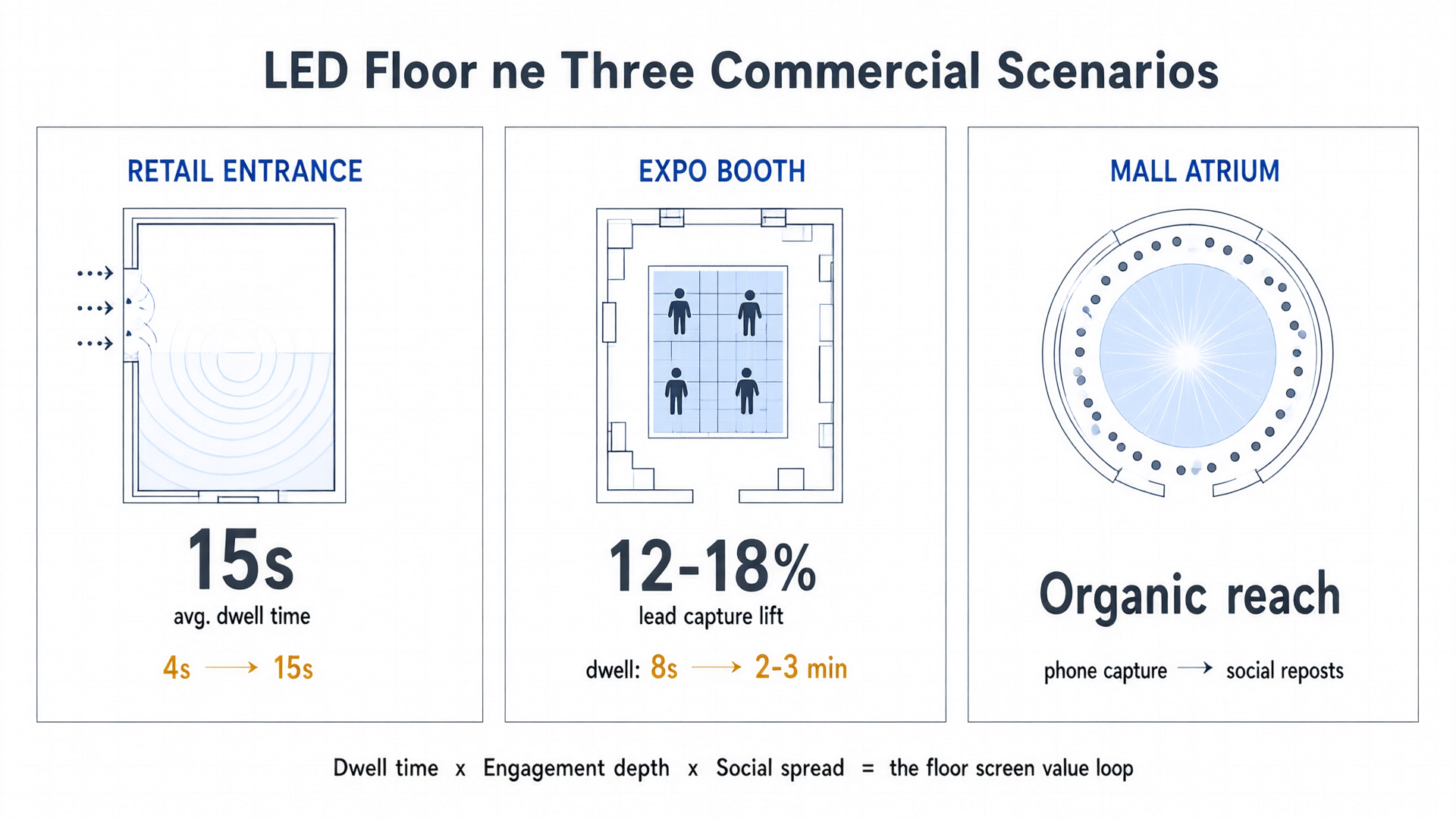
The LED floor screen fills the blind spot below eye level, converts footsteps into instant visual feedback, and turns foot traffic into measurable dwell time. Over 15 years of global deployments, the commercial value of Floor LED Displays has converged on three repeatable scenarios: retail entrances, exhibition booths, and mall atriums.
# Step, Play, Share: LED Floor Screens for Commercial Spaces
From March to September, the global exhibition calendar is packed — NAB Show, InfoComm, and ISE follow one after another. Advertising agencies and retailers leverage this window to source hardware that captures attention within a passerby's first glance. The LED floor screen is a key solution. It fills the blind spot below eye level, transforms footsteps and body movement into instant visual feedback, and turns foot traffic into measurable dwell time. Over our 15 years of global deliveries, the commercial value of Floor LED Displays has converged into three repeatable scenarios.
Retail entrances: intercepting the forecourt
The sidewalk in front of a flagship store is retail's most valuable real estate. A floor screen uses pressure sensors to detect pedestrian location and walking speed, then delivers real-time visual feedback underfoot—spreading ripples, shattering petals, or dispersing brand-mark particles. Shoppers glance down at their steps; average dwell time at the storefront rises from roughly 4 seconds to over 15, doubling content exposure. The data layer matches the visual impact: a sensor-connected backend exports hourly traffic curves, per-effect trigger rates, and stop ratios by zone, feeding structured insights directly into the next round of content iteration.
Exhibition booths: turning visitors into players
Visitors pass a booth in an average of 8 seconds. Interactive tiles turn that brief walk into a game: footsteps earn points, weight shifts control the on-screen character, and simultaneous steps from multiple players unlock a team stage. Visitors start playing instead of watching, extending their stay to two or three minutes. Agencies track the commercial impact: every additional 30 seconds of dwell time increases the rate at which visitors scan a code or share contact details by approximately 12% to 18%. Hardware requirements align with the show schedule — booth designers typically limit module thickness to 90mm or less and require per-tile load capacity above 1,500kg,, as the floor must withstand repeated impact cycles and dense crowds within a single event week.
Mall Atriums: Engineering the Perfect Shareable Moment
During holidays, seasonal openings, and brand pop-ups, a shopping center needs a live event worth capturing. Large-format tiling paired with programmed content brings the floor to life: water ripples spreading across the atrium, fireworks exploding at the center, and oversized letters illuminating one by one. Visitors lift their phones without prompting, turning their recordings into free organic reach on social platforms. The design is time-based. Content rhythm responds to crowd behavior in real time—accelerating as clusters form around the display and slowing as the area clears—so the surface feels like a living part of the space, not just a screen placed on the ground.
Three specification checks before committing
Selection decisions depend on three key metrics. First, protection rating: foot traffic, cleaning mops, and spilled drinks define the duty cycle of a floor tile, so the panel face must meet IP65 or higher—fully dusttight and resistant to low-pressure water jets. Once liquid bypasses the seal, lamp modules fail in volume within roughly 72 hours. Second, surface treatment: the tempered glass cover requires anti-glare etching plus an anti-fingerprint coating, because a mirror-polished surface turns overhead retail lighting into broad reflections that obscure the intended content. Third, refresh rate at recording distance: viewers stand 2 to 5 meters above the surface while cameras get closer; anything below a 3840Hz refresh rate produces visible scan stripes in recorded video, undermining the very social engagement the atrium scenario aims to deliver.
From scenario to delivery
All three scenarios share the same premise: a floor screen serves as one end of an interactive system, requiring seamless coordination among sensors, content engines, and display modules. Limeite Technology's Floor LED series supports custom panel sizes and load specifications, holds CE, FCC, and RoHS certifications, and is manufactured in our own 10,000+ sqm facility with delivery records across more than 50 countries. Finalizing specifications and layouts before the 2026 show season ensures that March load-ins never compromise requirements for delivery timelines.


